Types of Plumbing Fittings: A Complete Guide for Homes & Industries
Plumbing systems are the backbone of every residential, commercial, and industrial building. While pipes carry water from one point to another, plumbing fittings play an equally important role in connecting, controlling, and directing the flow of water. Without the right fittings, even the best piping system cannot function efficiently.
In this detailed guide, we will explore the different types of plumbing fittings, their uses, materials, and how to choose the right one for your project. We will also discuss commonly used plumbing pipe fittings, including PVC plumbing fittings and CPVC pipe fittings, which are widely used in modern water supply systems.
What Are Plumbing Fittings?
Plumbing fittings are components used to join pipes, change pipe direction, regulate water flow, or connect pipes of different sizes. These fittings ensure leak-proof connections and smooth water distribution throughout the system.
They are available in various materials such as PVC, CPVC, brass, copper, stainless steel, and cast iron. Today, plastic-based fittings like PVC and CPVC are highly preferred due to their durability, corrosion resistance, and affordability.
Why Are Plumbing Pipe Fittings Important?
The importance of plumbing pipe fittings goes beyond simple connections. They:
- Ensure proper water flow direction
- Prevent leaks and pressure loss
- Connect pipes of different diameters
- Help in maintenance and system repair
- Improve overall plumbing system performance
Using high-quality plumbing fittings increases the life of the entire water supply system.
Main Types of Plumbing Fittings
Let’s explore the most commonly used types of plumbing fittings and their functions.
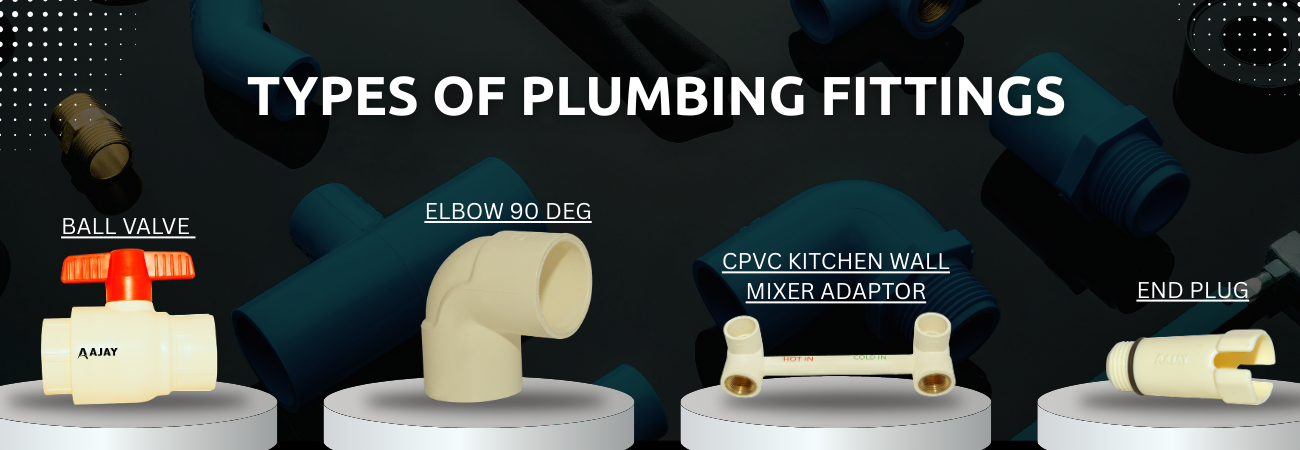
1. Elbow Fittings
Elbows are used to change the direction of water flow. They are typically available in:
- 45-degree elbows
- 90-degree elbows
These fittings are widely used in both residential and commercial plumbing systems. PVC plumbing fittings and CPVC pipe fittings often include elbow variants for cold and hot water systems.
Applications:
- Turning pipe direction in bathrooms and kitchens
- Adjusting pipe routes in tight spaces
2. Tee Fittings
Tee fittings are shaped like the letter “T.” They are used to divide or combine water flow.
Types of Tee Fittings:
- Equal tee (same diameter openings)
- Reducing tee (different branch size)
Tee fittings are common in water distribution systems where one main pipeline supplies multiple outlets.
3. Coupling Fittings
Couplings connect two pipes of the same diameter. They are essential when extending pipeline length.
Types:
- Full coupling
- Half coupling
- Reducing coupling
In modern construction, PVC plumbing fittings are commonly used as couplings because they are lightweight and easy to install.
4. Union Fittings
Union fittings are similar to couplings but allow easy disconnection for maintenance or repair. They are ideal for areas where periodic inspection is required.
Unlike standard plumbing pipe fittings, unions can be removed without cutting the pipe.
5. Reducer Fittings
Reducers connect pipes of different diameters. They help maintain proper pressure and flow when pipe sizes change.
Types:
- Concentric reducer
- Eccentric reducer
Reducers are widely used in both residential and industrial plumbing systems.
6. Cap Fittings
Caps are used to close the end of a pipe. They are helpful during system testing or when temporarily sealing unused pipe ends.
Caps are available in PVC, CPVC, and metal materials depending on system requirements.
7. Plug Fittings
Plugs are used to close pipe openings, usually inside threaded fittings. They are commonly used in drainage and maintenance applications.
8. Adapter Fittings
Adapters connect pipes made of different materials or types. For example, connecting a PVC pipe to a metal pipe requires a threaded adapter.
Adapters are widely used in mixed plumbing systems where different materials are combined.
9. Cross Fittings
Cross fittings have four openings and are used where four pipes meet at a single junction. They are less common in household plumbing but used in complex water distribution systems.
10. Nipple Fittings
A nipple is a short piece of pipe with male threads on both ends. It is used to connect two female threaded fittings.
Nipples are commonly used in metal plumbing systems.
Types of Plumbing Fittings Based on Material
Apart from design types, plumbing fittings are also classified based on materials.
PVC Plumbing Fittings
PVC (Polyvinyl Chloride) fittings are commonly used for cold water supply, drainage, and irrigation systems.
Benefits:
- Lightweight
- Corrosion-resistant
- Affordable
- Easy installation
- Long-lasting
PVC plumbing fittings are ideal for residential plumbing and agricultural pipelines.
CPVC Pipe Fittings
CPVC (Chlorinated Polyvinyl Chloride) fittings are designed for hot and cold water applications.
Advantages:
- High temperature resistance
- Durable and strong
- Chemical-resistant
- Suitable for drinking water systems
CPVC pipe fittings are widely used in homes, apartments, and commercial buildings where hot water supply is required.
Metal Plumbing Fittings
These include brass, copper, and stainless steel fittings. They are strong and durable but more expensive compared to PVC and CPVC fittings.
How to Choose the Right Plumbing Fittings
Selecting the correct plumbing pipe fittings depends on several factors:
1. Water Temperature
Use CPVC pipe fittings for hot water systems.
2. Water Pressure
Choose fittings that can handle high-pressure systems.
3. Pipe Material
Ensure compatibility between pipes and fittings.
4. Application Area
Residential, industrial, irrigation, or drainage systems require different types of fittings.
5. Quality Certification
Always choose fittings that meet quality standards for safety and durability.
Advantages of Using High-Quality Plumbing Fittings
Investing in good-quality plumbing fittings offers several benefits:
- Leak-proof connections
- Long service life
- Reduced maintenance costs
- Improved water efficiency
- Better system reliability
Low-quality fittings may cause leakage, cracks, and frequent repairs, leading to higher long-term costs.
Common Applications of Plumbing Fittings
Plumbing fittings are used in:
- Residential homes
- Commercial buildings
- Hospitals
- Hotels
- Industrial plants
- Irrigation systems
- Water supply networks
Both PVC plumbing fittings and CPVC pipe fittings are widely used across these sectors due to their efficiency and durability.
Installation Tips for Plumbing Pipe Fittings
To ensure proper installation:
- Clean pipe ends before joining
- Use proper solvent cement for PVC and CPVC fittings
- Avoid over-tightening threaded fittings
- Check alignment before fixing
- Test the system for leaks after installation
Proper installation significantly increases the life of plumbing pipe fittings.
Future of Plumbing Fittings
Modern plumbing is moving towards more durable, eco-friendly, and high-performance materials. PVC and CPVC fittings are becoming increasingly popular due to their sustainability and cost-effectiveness.
Innovations in plastic technology are improving pressure tolerance, chemical resistance, and lifespan of plumbing pipe fittings, making them the preferred choice in new construction projects.
Conclusion
Understanding the different types of plumbing fittings is essential for building a reliable and efficient plumbing system. From elbows and tees to reducers and adapters, each fitting serves a specific purpose in water distribution.
Today, PVC plumbing fittings and CPVC pipe fittings dominate the market due to their strength, corrosion resistance, and affordability. Choosing the right plumbing pipe fittings ensures leak-free performance, durability, and long-term savings.
Whether you are constructing a new building or upgrading an old plumbing system, selecting high-quality fittings is the key to long-lasting results.
FAQs
1. What are the most commonly used plumbing pipe fittings?
The most common plumbing pipe fittings include elbows, tees, couplings, reducers, unions, caps, and adapters. These fittings are essential for connecting and directing water flow.
2. What is the difference between PVC plumbing fittings and CPVC pipe fittings?
PVC plumbing fittings are mainly used for cold water systems, while CPVC pipe fittings can handle both hot and cold water due to higher temperature resistance.
3. How do I choose the right plumbing fittings for my home?
Consider water temperature, pressure rating, pipe material compatibility, and application area before selecting plumbing fittings.
4. Are CPVC pipe fittings suitable for drinking water?
Yes, CPVC pipe fittings are safe for potable water systems and are widely used in residential and commercial water supply networks.
5. How long do PVC plumbing fittings last?
High-quality PVC plumbing fittings can last 25–50 years depending on installation quality and usage conditions.